
I was deaf for twelve years before a surgery that wasn't supposed to work. This is what came before, what came after, and how I ended up writing code from an island.
Ancona, the years before
I was born in Ancona in April 2001. A coastal city on the Adriatic, the kind of place people drive past on their way somewhere else. My family lived in social housing — case popolari — until I was thirteen. We didn't have much money, and the people I grew up around were the people you meet in those buildings: real, plain, present.
My parents separated when I was two. My mother stayed in Ancona. My father moved to Falconara, twenty minutes up the coast. Tuesday and Thursday nights, plus every other weekend, I'd be at my father's. The rest of the time at my mother's. My brother Riccardo — Riki — did the same rotation. We were four years apart, and for the first fifteen years of my life he was the constant on every side of every house.
That rotation sounds complicated written down. It wasn't. It was just my life.
Family
My mother is Yvonne. She worked at Vissani designing interiors for homes — she was good at it, the kind of good that gets remembered. When my brother was born she chose stability over career and moved into Regione Marche, the regional public administration, where she's been ever since. She married Giuseppe, and they had my younger brother Alessandro. The three of them, plus me on rotation, became my home in Ancona.
My father is Francesco. He worked outdoor markets in one of Ancona's main squares, then became a gardener on the Conero coast with a small team, then opened his own gardening business that ran for years — its logo was the Bodhi tree. I remember the business cards we handed out. Today the leather notebook I write in is recycled paper, with that same Bodhi tree on the cover. Some things you don't choose to inherit. They just become you.
His knowledge of plants is the kind you only get from doing the work for decades — he can name what's growing in a field by the leaves, by the smell, by how it moves in the wind. He passed that on to me whether I wanted it or not. Now I notice plants. I know what they are. That's him.
His partner Claudia had a daughter eleven years older than me, Giulia. To me she's never been anything other than my sister — I grew up with her in that house. The five of us — my father, Claudia, Giulia, Riki, me — were the Falconara version of family.
Both my parents are Buddhists. Both vegetarians. They chanted Nam-myoho-renge-kyo in front of the Gohonzon — the scroll that anchors the practice in Nichiren Buddhism. My father still chants every day. My mother stopped a few years ago. During the years of my surgeries they chanted for me. Sometimes I chanted with them. The mantra was background noise of my childhood the way other people's childhoods have a radio. I didn't know it then, but chanting gave me a peace I didn't know I needed. It taught me, without saying so out loud, that the secret to a life is to slow down and reflect — to be aware of what's happening, so you can change it, so you can move toward what you actually want.
My grandfather was a farmer. Contadino. We ate what he grew. When I was sick, which was often, my parents treated me with natural medicine. They're experts in homeopathy and medicinal plants. The antibiotics for my ear infections were specific and prescribed, but everything else around them was holistic — slow remedies, herbs, the body trusted to heal if you gave it the right conditions.
My father taught me values through being present: education, respect, love for things, the discipline of finishing what you start. He taught me to be unafraid of nature, of physical effort, of getting tired in good ways. When I was small he carried me on his shoulders down the path to Mezzavalle every Sunday in summer. It's one of the most beautiful beaches in Italy — a long descent through wild Mediterranean scrub down to the Adriatic, the Conero cliffs rising behind. We went to adventure parks together: zip-lines, climbing trees taller than houses, swings rigged high in the canopy. He wanted me to know what my body could do.
My mother held the other line. She made sure I had words for what was happening to me. She made sure I knew the names of the doctors, the names of the drugs, the difference between the procedures. She made sure I could think about my life, not just survive it.
I had two dogs growing up. Maya, a Canadian golden retriever, was with us from when I was small until I was in high school. Luna, a mixed breed, came after and died recently. Maya is tattooed on my body. Luna isn't yet, but she will be. When you grow up in a house where the adults are often working, the dogs become co-residents — not pets exactly, more like roommates with better souls.
The diagnosis
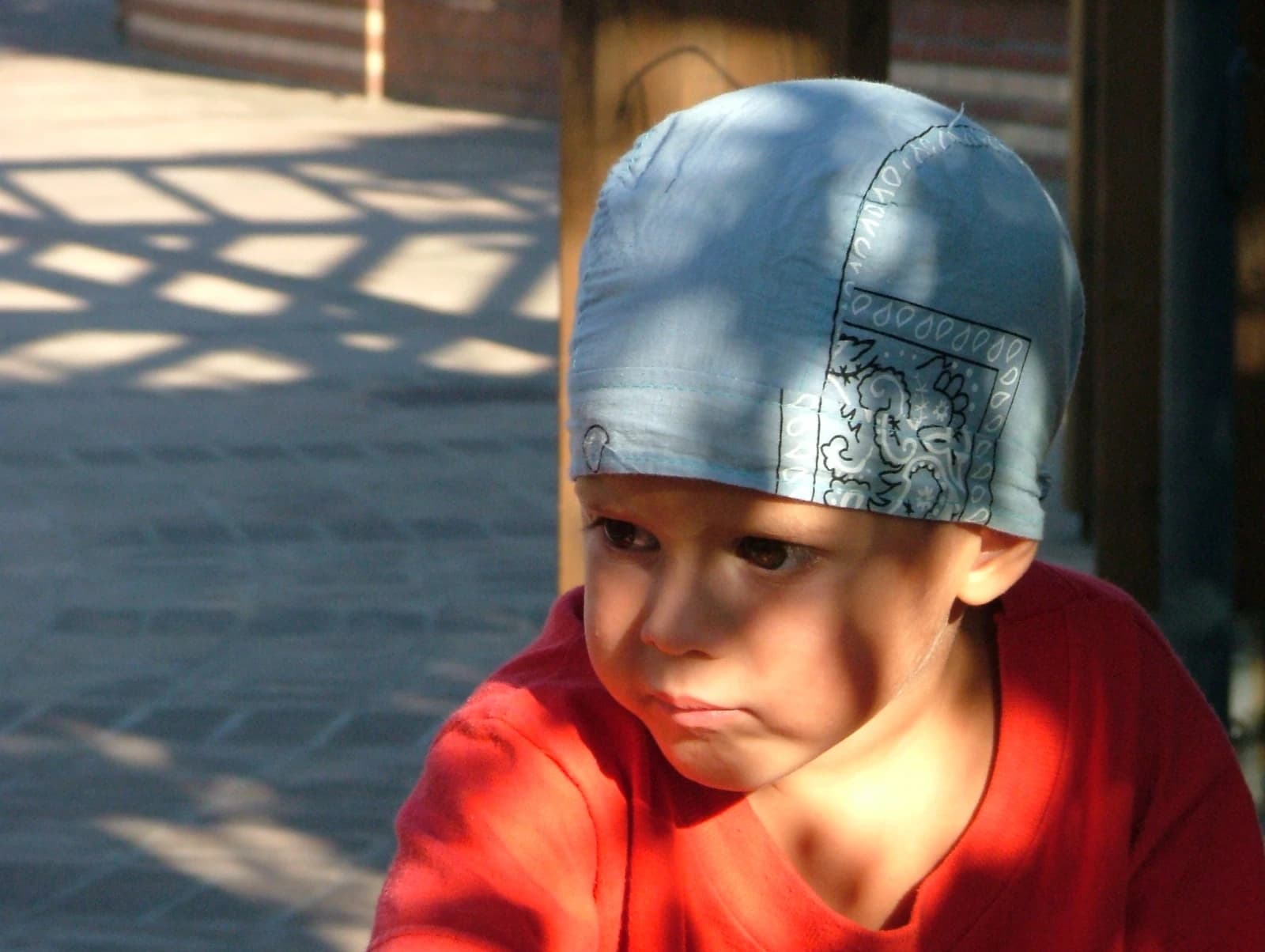
I was two years old.
I had adenoiditis — inflamed adenoids — and the diagnosis was missed. Mucus built up where it shouldn't have, slow and silent, until it perforated both my eardrums. By the time the right doctor saw me, the damage was already done. The verdict was final, the way these things are sometimes spoken to families who can't afford a second opinion in another city: your son will go deaf.
That is the kind of sentence that ends one version of a child's life and begins another. My parents didn't accept it. They started driving.
For the next several years they drove me across Italy — anywhere a specialist might have a different answer. We'd leave Ancona before dawn, find the hospital, sit through the appointment, drive back the same day. The money for hotels wasn't there. The money for the visits barely was. They never told me how tight it was. I figured it out later from the way they spoke about that period — quietly, the way you talk about a war you survived.
I don't remember being scared in those years. I remember being cold in hospital corridors. I remember the smell of waiting rooms. I remember my mother holding a folder full of every report, every audiogram, every prescription, in order, and producing the right document at the right moment in the right office. She had built a small archive of my body, and she carried it from city to city.
Twelve years
What followed was twelve years of partial silence.
It wasn't total deafness. It was worse in a way — it was almost. Sound came through filtered, muffled, like listening to the world from inside a closed bag. Some voices reached me clearly. Most didn't. Conversations in groups were a negotiation between what I'd actually heard and what my brain had reconstructed from the parts that came through. I learned, very early, to read faces. I learned to read shoulders. I learned to laugh at the right time even when I hadn't caught the joke.
The infections were constant. Water in either ear meant another round of pus and pain and antibiotics. The antibiotic prescribed for my ears had a particular smell — sharp, medical, unmistakable — and I can still smell it now, more than ten years later, the way some people can still smell a perfume that used to belong to someone they loved. Mine just means infection. The smell still makes me cold.
I couldn't shower in the locker room after sport. I had to go home and have my parents wash my hair for me, my ears wrapped, the water carefully kept away. No swimming pools. No long showers. Hair shaved short so wounds could breathe. I was also lactose intolerant — at a time, in Italy, when school cafeterias didn't have lactose-free options. So at lunch I either ate a different meal from everyone else or I didn't eat. Small things, daily things, that pile up into the texture of being a child who is always almost like the others but never quite.
School was where it got harder.
In second grade, my teachers moved me to the back of the classroom because of the smell from the infections. I was eight. They didn't explain it that way at the time, but children figure these things out. From the back of the room, with poor hearing and a sense that I was being quietly excluded, I stopped being able to follow. When my parents understood what was happening, they had me transferred to another section. The new section was further along in the curriculum — they had already started Italian grammar; my section hadn't. I missed the entire grammar foundation. I never recovered it fully. To this day I write more confidently in code than in Italian prose.
Teachers would scold me for asking them to repeat things. Some treated me with the impatience reserved for slow kids — a category they'd silently assigned me to. I felt it. I remember the anger more clearly than the sadness. The sadness blurs. The anger at being underestimated by people whose job was to see me sharpens with time.
And yet. I had friends. A lot of them.
I never wanted to be the kid who got pitied. From very early on I made a decision — not consciously, just the way kids decide things — that I would be the cheerful one. The one who showed up smiling. The one who made other kids laugh. After my second surgery, fresh out of anesthesia, wrapped in bandages, I got out of bed and ran down the hospital corridor to greet every nurse on the ward. They were stunned. My family was stunned. That stayed with me as a small private theory of how to live: the pain goes inside, the energy goes outside. The pain is real, but you don't owe it to the world. You owe the world your best version.
This is the thing about being a child who is different. You can spend your life resenting it, or you can decide — at some point, often without realizing you're deciding — that the difference is a gift in disguise. I made that decision somewhere between the second and the third year of school. I don't remember the moment. I just know that by the time I was ten I no longer thought of my ears as my problem. I thought of them as my situation. And I had figured out that situations can be worked around.
By twelve I was moving on my own across Ancona, Falconara, and the towns around — buses and trains the way other kids used their parents' cars. I had the kind of independence kids in cars don't get. I had to. I had nowhere else to put the energy.
"The pain goes inside, the energy goes outside. The pain is real, but you don't owe it to the world."
The four operations
When I was eleven, my mother found a doctor in Padova who thought he could help.
He was older. Toward the end of his career. We didn't have the money for hotels, so we drove. Operation, recovery in the hospital, drive home. Then the wait for healing. Then the appointment to check whether it had worked.
It hadn't. The eardrum had reopened. The graft hadn't held.
He told us he was retiring, and that we should continue with his right hand: a younger surgeon named Trabalzini. He spoke of him as promising — very capable, the protégé who would carry the work forward. We tried again the following August, on the other ear, with Trabalzini using the same technique he had inherited.
It failed too.
Two surgeries, both ears, both failed. Most surgeons would have closed the file at that point. Most families would have stopped driving. We did neither.
Trabalzini went back to study. He had heard about a new approach being used in the United States — rebuilding the eardrum with cartilage rather than the standard graft material. It had never been done in Italy. He worked on it for months. He came back to my parents with a proposal more honest than reassuring: he didn't know if it would work. He believed it could. He would try.
The third surgery — third August, my left ear — was August 2014. I was thirteen. I would be the first patient he attempted this technique on in Italy.
I lived the operations well. I didn't worry. To me they were a kind of vacation — quiet days when I was allowed to do nothing, hospital food I was strangely fond of, time off school. I remember the cold of the operating room more vividly than I remember the fear, because there wasn't much fear. I had decided, the way I always decided things, that this would also be fine. I had run out of room for worry.
The third surgery worked.
Trabalzini repeated the technique the following August on the other ear. The fourth surgery, August 2015. I was fourteen.
It worked too.
I was, in Italy, his patient zero. The technique he developed on me became the technique he used on hundreds of children after. Today Trabalzini is head of department at the Meyer in Florence — the most important pediatric hospital in the country. Years later, as an adult, I went to see him. I sat across from him in his office and thanked him properly, the way I couldn't have at fourteen. He had given me a working life. There aren't many ways to repay something like that. Showing up to say it out loud is the closest I could manage.
Sound
The change wasn't dramatic.
When the bandages came off after the first two surgeries, I hadn't noticed any difference. The world sounded the same — muffled, sideways, the same private negotiation with reality. The hospital had done its work and the work hadn't held. The bandages came off and life went on.
The third time, my parents were doing the medications at home — cleaning the stitches, checking the healing, the careful labor of post-op care that they had become experts in. The bandages came off and something was different. Not loud. Not theatrical. There was a freshness in the ear, as if clean air were passing through where there hadn't been any for as long as I could remember. The dense feeling — that closed, plugged sensation that had been the baseline of my hearing for twelve years — was gone on one side. I could hear from the right ear properly. The left, not yet operated, still muffled in its old way. The contrast told me everything.
The next August, the contrast disappeared. Both ears worked.
The first sound I remember from those weeks is hard to pin down, because the transition wasn't a movie. There was no orchestra. No first word that made me cry. It was the slow accumulation of small fresh things — the way air moves differently through an open ear, the way smells seemed sharper because hearing was contributing to perception again, the way my own voice came back inside my head with an edge it hadn't had. My senses came back into balance with each other. The world stopped being a guess.
The word I used, when I tried to describe it later, was mistico. Mystical. I don't use that word lightly. I don't use it at all anymore — it sounds embarrassing now to say in English. But what I meant was that there was a sense, in those weeks, that something invisible had shifted into the right place. As if the universe had been holding its breath for twelve years and now exhaled.
I was fourteen. I had finally heard the world clearly. And I had no idea what to do with that.
"My senses came back into balance with each other. The world stopped being a guess."
The street
After the surgeries, I came back into a world that had been waiting for me, and I had a lot of energy to spend.
The center of my childhood — the social center, the place where I learned how to be with other people — was Parco Kennedy in Falconara. A public park, the biggest one in the city, full of kids and families from every part of town. We met at the football pitch. We played, then we wandered. The wandering taught me more than the playing did.
We were the kids who explored. Abandoned houses. Abandoned buildings. Rooftops we shouldn't have been on. We talked to the foreigners. We talked to the homeless men around the park — sat with them, listened to their stories, spent whole afternoons on benches hearing about lives that didn't fit anywhere else. Looking back, I learned more about human beings in those afternoons than school taught me in twelve years. People who have nothing left to lose tell the truth differently than people who do.
When I started high school in Ancona, my territory expanded. The historic center became another home — Cardeto park, the harbor, the Passetto cliffs and the monument above them, the cathedral. I'd take buses and trains between Ancona and Falconara, moving between the two cities the way other kids moved between their bedroom and their kitchen. Two different geographies, two different versions of myself, both real.
Leo and Mauro entered my life at Parco Kennedy. They've been the constant ever since.
We did our firsts together. First time out alone. First cigarettes. First time talking to girls. First summers as semi-independent humans. First mistakes. First time we realized that the world outside our parents' houses was its own place with its own rules, and we had to learn them. We did all of it side by side. Even in years when we drifted — different schools, different paths, different cities — when we came back together it was as if no time had passed. We've never argued. The bond has never depended on circumstances. Leo is in Tenerife with me now, and he may come to Bali next. Mauro is the other home I always have. People like that aren't friends in the modern sense. They're family you happen to have chosen.
Sport was a constant background. Judo for seven years, from when I was small, up to a brown belt. Taekwondo for two years with Leo. Atletica for a season. Basket for a season. Football for two. None of it became my identity — I was an enthusiast more than an athlete — but moving my body daily, organized and disciplined, gave me a frame for the rest. I still follow every sport I can — MotoGP, Formula 1, football, watching wherever I am.
Then there were years that didn't go well.
I'm not going to detail them. I made mistakes. I did things I shouldn't have done. There were stretches when I was darker than I'd ever been before or have been since. I tried things I now wish I hadn't tried. I came out the other side eventually, on my own terms, and I came out clearer for it. But the years happened. I don't pretend they didn't.
There's a thing I've come to believe about the dark periods: they are part of what brings you to the light. You can't think your way out of suffering. You have to live it through. The Buddhism around me as a child had been preparing me to understand this, but I had to learn it for myself, the slow way, because that's the only way it sticks.
In 2017 I made my first trip abroad. Edinburgh. My older brother Riki was already living there, and I went to visit him. It was my first flight after the surgeries, the first time I was cleared to fly without fear of pressure changes destroying my ears. The world had been geographically closed to me for sixteen years. That trip cracked it open. I remember the air in Edinburgh — cold, wet, foreign in a way nothing in Italy had ever been. I remember the feeling of having gotten on a plane and arrived somewhere else, and the dawning sense that this was something I would do again.
The year after, the second year of liceo scientifico, I was held back.
The bocciatura was bad. I felt it as injustice — I knew the material was inside me, even if my grades didn't show it. I knew I had a clean reason for the gaps. I knew my brother had just left for another country and I was suddenly the only sibling at home in a family already stretched thin. None of it counted. The institution didn't care about reasons. It only cared about results, and I hadn't produced enough of them.
That summer was hard. I was angry, mostly at teachers who had treated me with the small contempt of authority figures who get to decide who deserves attention and who doesn't. I felt the contempt and I never forgot it. The anger from that period is one of the engines that's still inside me — not bitter, not vengeful, just very alert to the way people in power can quietly write off the ones they're supposed to serve. I notice it now in any system I'm part of. I am not going to be a person who does that.
I started over at the ITIS — meccanica e meccatronica, a technical institute. The atmosphere was different. The teachers were less precious, the work more practical, the kids more like me. I started doing better, at least in the subjects I respected — mathematics, physics, anything hands-on. The theoretical subjects I never engaged with. I had decided, by then, that I was going to do my own studying for the things I cared about, on my own terms.
In 2018 I moved permanently to Falconara, to my father's house. The Tuesday-Thursday rotation ended. My mother's side of the family I still saw, but the daily structure became Falconara. For a year we hosted Marcos, an Argentinian a few years older than my sister, who lived in my room. He arrived not long after Riki had left for Edinburgh, and his presence in the house meant a lot — still does. Every time we see each other now, even years later, there's a bond that picks up exactly where it left off. Some people enter your life at the right time and stay there even when they're not physically around.
The dogs were my actual company in those years. Maya and Luna — there when I came home, the certain greeting at the end of every day. They had always been part of the family, but during those years they earned a different place. Days at the sea with them. Days in the countryside. Long walks, summers spent outside together, the kind of memories you don't realize you're collecting until much later. I have never undervalued what those two did for me. I carry every one of those days with me.
I graduated from the ITIS in 2021. Sixty out of one hundred. The minimum. I had spent five years deciding what I refused to learn from people who hadn't earned the right to teach me, and I left high school with exactly what that decision was worth on paper.
I knew the paper was lying. I just didn't know yet what was true.
Code
After the diploma, I took a year and a half off.
It wasn't a sabbatical in the elegant sense — it was a real-world year. I worked summers as a bagnino — beach lifeguard — in Falconara. Winters I rode for Deliveroo in Ancona, on a scooter through cold rain, dropping off pizza and sushi at the doors of people who didn't look up. Modest work. Real work. The kind of work that doesn't dignify you or undignify you — it just is what you do until you figure out what's next.
I spent that year and a half searching online, reading, watching, asking — trying to understand what to do next. I had no university plan because university wasn't right for me — too much theory, too slow, too far from the kind of practice I wanted. I wanted to learn by doing. So I dug. I followed people who had already gone the way I thought I wanted to go. I tried to figure out who was lying and who was telling the truth.
I had been following a YouTuber named Marcello Ascani for years. Italian, around thirty, the first proper public face of digital-nomad life in our country. He talked about travel, about making a living through a laptop, about the kinds of work that wouldn't require a fixed office in a fixed city. I watched his videos the way some kids watch interviews with athletes. He was modeling, in real time, a life that I knew, somewhere in me, was the one I was going to try to build.
One of his videos was about Start2Impact, an Italian online school for digital careers. I clicked. I read. It made sense in a way university hadn't.
In December 2022 I started the Master in Full Stack Development. I was twenty-one. The course was self-paced, project-based, mostly in English — which I didn't speak fluently at the time. I spent late nights with documentation tabs open and a translator beside them, rebuilding my comprehension of a second language in the same months I was rebuilding my comprehension of programming. Both languages came in slowly, then suddenly.
My parents had been quietly skeptical. They had grown up in a world where you traded hours for money in stable jobs, and they wanted me to be careful with the rent and the groceries. They never tried to stop me. They tried to make sure I knew what I was choosing. I lived simply, said no to most things, kept my expenses small, and put the time into the laptop.
The Master taught me Full Stack Development properly — React, Angular, Node.js, the full pipeline. But what it gave me that I hadn't expected was a community. Other students, instructors, people a few steps ahead of where I was, sharing the things they had figured out so I wouldn't have to figure them out the slow way. The Buddhism-shaped part of me already knew that the fastest path through a forest is sometimes following someone who's walked it before. The Master made that knowledge concrete.
The first months were a battle with perfectionism. Every project I submitted felt almost-good-enough but never-actually-good-enough. The fear of being seen as not-yet-enough was loud. The instructors and community helped quiet it down, slowly. The trick — and it took me a year to learn it — was to ship the work. To put it in front of someone. To accept the feedback. To go again. Aprirsi agli altri. Opening up.
In January 2024 I joined Altesia, a software house in central Italy, partner of Zucchetti. I started as an intern. The work was unglamorous — modernizing legacy VB6 systems into Angular and .NET web apps for the Fileni Group, a large food-processing company in the region. Agile team of seven, daily standups, real users, real deadlines, real consequences when things broke.
The first day was the day I understood I had made it through. Not made it in any final sense — but made it past the line where you can still convincingly tell yourself you might not make it. I had a job. I had a salary. The nights at the laptop had built something. The diploma's 60/100 had been wrong.
In October 2024 Start2Impact published an interview with me — a video and a written profile in their Storie di Successo series. I watched it back the way you watch yourself on a recording: a little uncomfortable, a little surprised by the person on the screen. The boy who had been put in the back of the classroom at eight was being asked, at twenty-three, what advice he had for other people trying to change careers. I said the thing that was true: that fear of failure is a self-imposed block, and the way through it is opening up to other people.
I was working at Altesia by then. I had no idea I would leave it three months later. I had no idea what the next year would do to me.
In January 2025 I joined Airplay Control, full remote. They built broadcasting systems for major Italian TV networks — RAI, La7, others — with servers across Europe monitoring the transmissions in real time. Infrastructure-critical work, the kind where the consequences of a problem are visible immediately to the broadcaster and the audience. I learned a lot, fast. The senior engineers I worked with were generous in a way that made the steepness of the learning manageable.
But the real change wasn't the job. The real change was the model: I was working from anywhere. The office had moved into my laptop. The world had geographically opened in 2017 with that first flight to Edinburgh. The geographical opening was now becoming a structural fact of my work. I could go anywhere with WiFi.
I was going to go somewhere.
The pivot
In September 2024, between Altesia and Airplay, I took a week to go see my cousin Miki in Barcelona.
Miki is older than me, a serious traveler — he had been telling me stories of the world for years, the way some older cousins tell stories of fishing or cars. I went to him at a moment when I needed to be reminded of the inner child — the version of me that wanted things, that believed things were possible, that hadn't yet learned all the small adult disciplines of giving up.
We walked a lot. We took ice-cold plunges. We talked about everything — life, work, family, fear, the choices people make and don't make. He gave me back something I had been slowly losing: the felt sense that I was, underneath everything, the same kid who used to take buses across Ancona alone at twelve. I came home lighter. I came home with a private decision I hadn't yet formed into words.
Earlier that year, during a hard stretch at Altesia, my mother had given me a book. Profondo come il mare, leggero come il cielo, by Gianluca Gotto. He's an Italian writer, a digital nomad like Ascani but in a different register — slower, more contemplative, more directly Buddhist in his framing of how to live. The book described his own encounter with Asian Buddhism, the kind he had found by going there and staying. My parents had given me the Buddhism of my childhood; this book gave me the version a young man could choose for himself as an adult. I read it the way you read a letter from someone who knows you better than you'd realized.
Later I read his novel Succede sempre qualcosa di meraviglioso, set partly in Vietnam. By the end of that one I had made a decision: I was going to Vietnam alone for Christmas and New Year.
I chose Phu Quoc, an island in the south. A jungle and beaches, still off the main tourist routes, the kind of place that hadn't fully decided what it wanted to be. (Years later I'd notice the strange coincidence: rotate Phu Quoc forty-five degrees on a map and it has the same shape as Tenerife. Two islands, two ends of the world, two places that would change my life.)
I went alone. Twenty days. I had nothing scheduled. I had nowhere to be.
What changed me there wasn't the Buddhism, exactly. The Buddhism I knew. What changed me was seeing an entire population — not monks, not teachers, regular people doing regular jobs — living the practice as a daily texture of life. Not as a belief. Not as a doctrine. As how they were. Skilled chefs running small street kiosks, working their craft for almost nothing. The woman selling fruit and vegetables at the market. They moved through their work with a calm that I had only ever seen in my parents during chanting, never in workers in Italy. The practice wasn't separate from the life. It was the life.
Every evening I'd walk down to watch the sunset. They were the best sunsets I have ever seen — colors I hadn't known the sky was capable of. Afterward, fireworks. A small display every evening, a major one on Saturdays, in a place called Sunset Town in the south of the island, considered one of the best in the world. I stood there alone for twenty nights and let the sky entertain me.
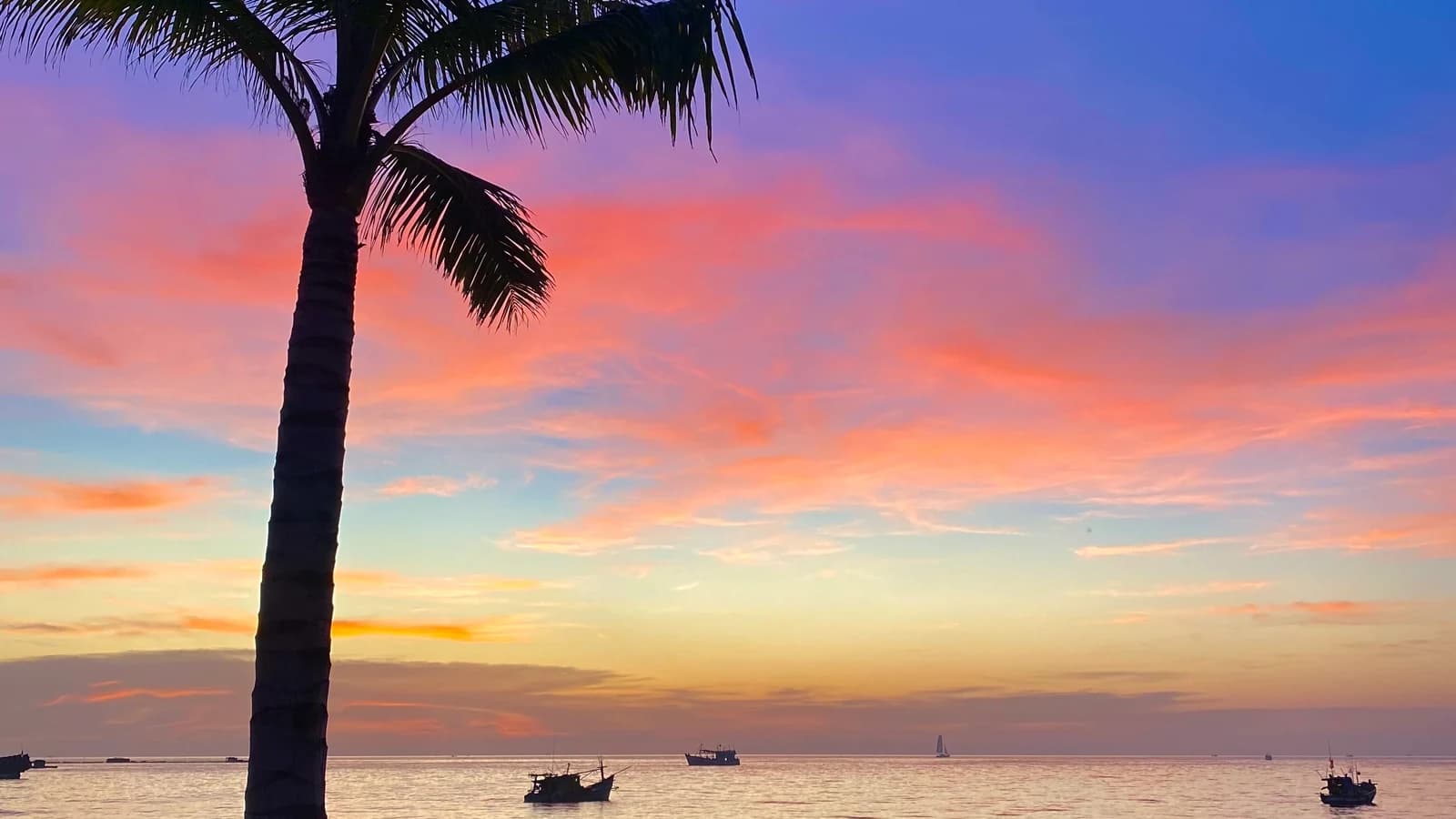
I came back to Italy at the start of January 2025. I joined Airplay. I started running, training, planning my next steps. I knew the next move was leaving Italy. I didn't know yet how soon, or where.
In March 2025, playing five-a-side football, I tore my rectus femoris — ninety-five percent of the muscle. The doctor told me I would be off my feet for four months.
Those four months were not lost time. They were the most important months of the entire story.
I was in bed with serious pain. I couldn't train. I couldn't walk far. I could think. And I could open my laptop.
What had been a private knowing, vague and unscheduled, became a concrete plan during those nights. I had a salary. I had savings. I had skills. I had a body of work building up at Airplay and a portfolio I was starting to build on my own. The next step was to take my work out of someone else's structure and put it into mine. I would be a freelancer. I would build it under my own name. I would call it Angel1 — from my surname, Angelone, but also as itself: angel one, the first angel, the one I imagined myself to be. Always cheerful. Strong. Determined. Capable of loving without conditions. Unafraid of suffering, because I had long ago understood that suffering is part of life and you don't get to skip it. Yin and yang. I have the word for angel tattooed in Japanese on my neck. I had been signaling this name to myself for years without committing to it.
In April 2025, still recovering, I made the decision out loud. I told my parents. They had always given me the freedom to choose, and they gave it again — not with reluctant approval, but with the full faith they had always extended to me. They knew, they said in different words, that I was going to find my way. They had known since the hospital corridors fifteen years before.
By the time the leg healed in July 2025, I was Angel1. Not yet a registered company. Just a name, a plan, a portfolio in progress, and the start of a different chapter.
In October 2025 I drove south through Spain — Barcelona, Alicante, Málaga, Cádiz — a road trip my sister Giulia had described to me years before. Ten days of coast roads with the car loaded down with monitor, chair, training gear. The trip wasn't only a holiday. It was a moving plan: I was relocating to Tenerife.
By November I was on the island.
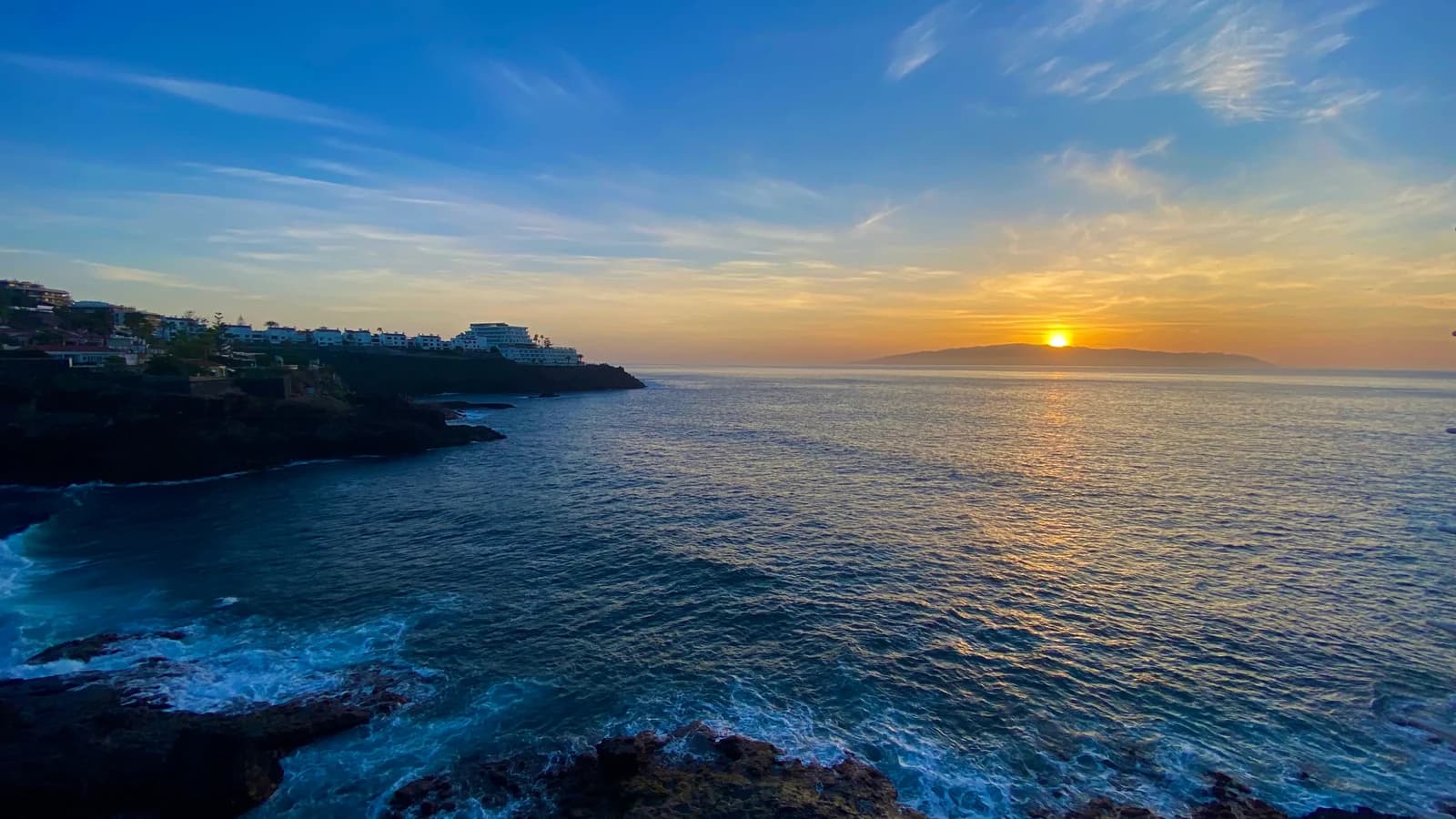
Today I write code from Tenerife. I am building toward Bali — I'll be there in early July 2026. The work supports the travel, and the travel supports the writing, and the writing supports the next thing, and the next thing isn't decided yet.
What I know is this: the twelve silent years were not lost time. They were the apprenticeship. They taught me to read situations, to read people, to read silence itself. They taught me that you can't argue with reality but you can negotiate with it. They taught me that the worst things in your life can become the engine of the best things, if you stay alive long enough to let them. The Buddhist part of me, the part I was raised inside and only later chose, would say that pain and joy are not opposites but two sides of the same coin — yin and yang — and that the secret to a life is to honor both without grasping at either.
"The twelve silent years were not lost time. They were the apprenticeship."
I write code now. I ship products for founders around the world. I do it from islands. I document the road as I go, and the road, the road is long and the road is mine.
This is the version of myself that fits.
The work continues.