Why I built it
Building a RAG system is the easy part. Knowing if it's any good is the hard part.
When I shipped Lore — the multi-tenant RAG support copilot in this same portfolio — the question that wouldn't go away was: how do I know retrieval is working? Vector search returns chunks. The LLM writes an answer. The answer looks fine. But "looks fine" isn't a metric, and "fine" isn't a SLA.
The harness I built for Lore's internal evaluation was useful. It was also coupled to Lore's specific endpoint, schema, and chunking strategy. The third time I caught myself copying the eval code into a new project — different endpoint, different response shape — I extracted it into a standalone tool. That's angel1-rag-eval.
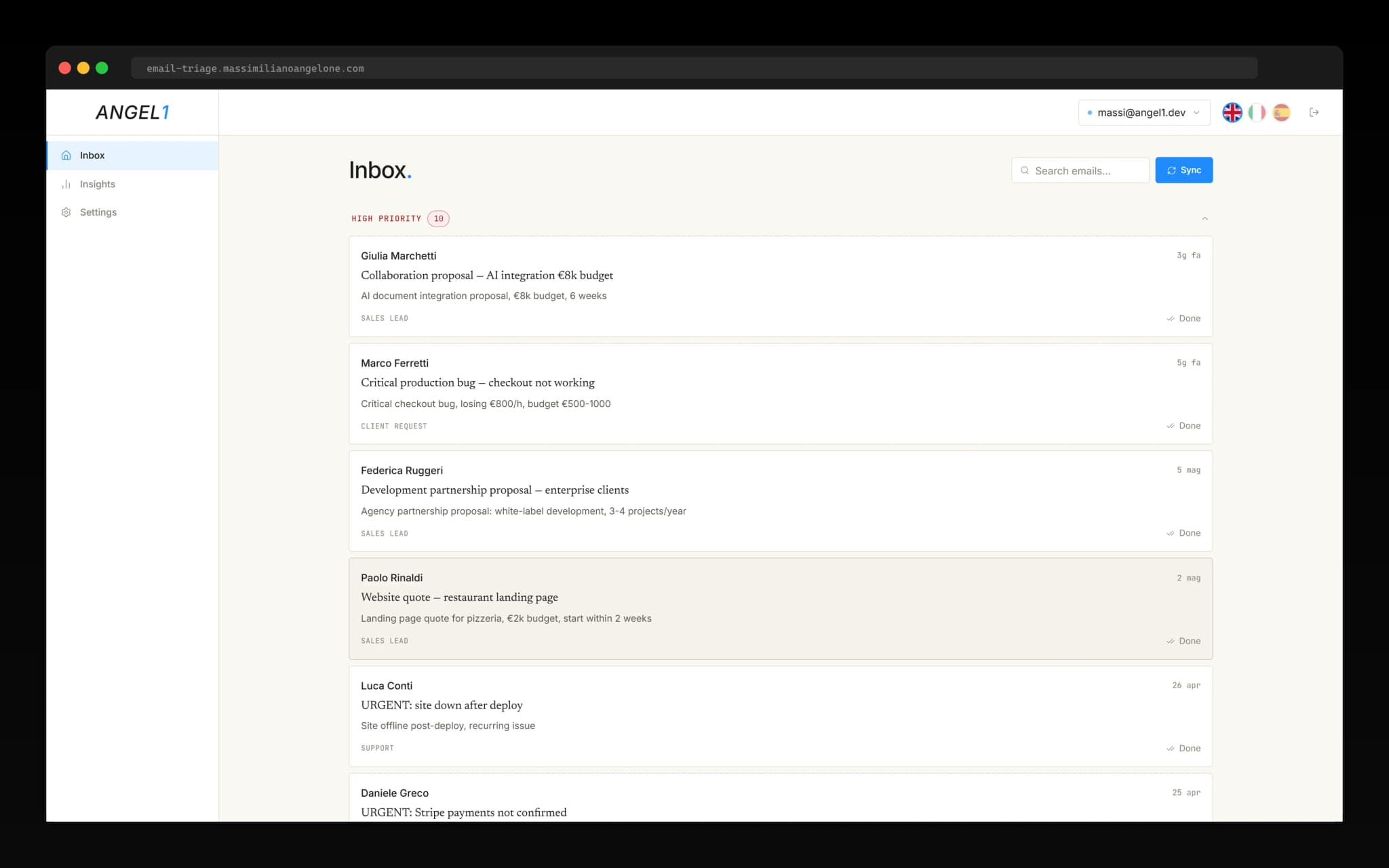
Same workflow as the toolkit: take the engagement scaffolding I run on every project, polish it, publish it. One tool to scaffold, one tool to measure. Companion CLIs for the same engineer, the same workflow.
What it does
angel1-rag-eval runs your RAG endpoint against a labeled eval-set (JSONL) and reports three numbers:
- Retrieval precision @K — did your retriever find the right documents?
- Faithfulness — is the generated answer supported by retrieved context, or did the model hallucinate?
- Correctness — does the answer match the expected ground truth?
Faithfulness and correctness are scored by a judge LLM. Out of the box: Claude (Sonnet 4.6) or OpenAI (gpt-4o-mini), selected by config. The judge runs structured output with strict JSON schemas — so when retrieval drops below threshold, you get a number, not a vibe.
Output: console table, CSV for spreadsheets, JSON for CI. Exit code 0/1 based on overall score threshold. Plug it into a GitHub Action and you'll see RAG quality regressions before they ship.
Architecture
The tool is small on purpose — under 1.3k lines of TypeScript. One command (run), four conceptual modules:
- adapters/endpoint — calls your RAG endpoint with templated requests, extracts answer + sources + (optional) source contents from configurable response paths. Path syntax supports nested objects and array map (
sources[].id). - core/scorer — retrieval precision @K against the labeled
expected_sourceset, plus the orchestration glue incore/runner.tsandcore/judge.ts. - providers/ — judge LLM dispatch. Strict JSON schema validation on output. Provider-agnostic interface — adding a third judge is a single file.
- formatters/ — three output formats. Table renders to stdout via
cli-table3. CSV and JSON are written to disk when--output <dir>is set, producingeval-<timestamp>.csvandeval-<timestamp>.jsonside by side.
Zero state. The whole tool is argv → fetch → score → render. No database, no cache, no config server. It's a CLI; CLIs should behave like CLIs.
The judge decision
Two judge providers, picked deliberately. Faithfulness scoring is the dimension where it actually matters — the judge has to read the retrieved chunks and decide if the answer is grounded.
gpt-4o-mini works because the task is constrained: short JSON output, structured schema, low temperature. Cost is negligible — a typical 100-question eval-set costs cents.
claude-sonnet-4-6 is the option I'd reach for when the retrieval is dense, the context is technical, or the answer is reasoning-heavy. Claude tends to be stricter on faithfulness, which is what you want when the system is shipping to paying users.
Both are interchangeable via config: same JudgeInput, same JudgeOutput, same schema validation, same JudgeError taxonomy. The application code never knows which one is judging.
What I'd do differently
Three honest limits at v1.0:
Claude judge end-to-end testing scheduled for v1.1. The structural pipeline is in place — schema parsing, error mapping, retry handling, all unit-tested. End-to-end validation against the Anthropic API is intentionally held for v1.1, after the first round of real-world feedback informs which edge cases the test set should actually cover. OpenAI judge is fully end-to-end validated. The README documents the gap; this case study doesn't paper over it either.
Faithfulness requires sourceContents in the endpoint response. Many RAG implementations return source IDs only (["doc-42", "doc-87"]) — efficient for the network, but the judge can't assess faithfulness against opaque IDs. The tool handles this gracefully (returns null for faithfulness, redistributes weight to retrieval and correctness) but you lose half the signal. Endpoints that want full evaluation need to return the chunk text alongside the ID.
No incremental cache. Re-running an eval after a prompt change re-runs every judge call. For a 500-question eval-set with Claude judge, that's real money and real time. A simple (question, answer, context) → score cache keyed on hash would solve it. It's on the list, not in v1.0.
What's next
Three threads in priority order.
Recall and nDCG metrics. Precision @K is the most actionable number, but recall matters for long-tail questions and nDCG handles ordered relevance. Both are one helper function away in the scorer module.
Streaming output. Today the tool prints results at the end. For 500-question runs you watch a spinner for 20 minutes. Streaming per-question results to stdout as they complete is a UX fix, not a metric fix, but a real one.
Better failure mode for malformed configs. Today's Zod validation catches schema errors but returns one error at a time. A multi-error report would let you fix five config bugs in one round instead of five.
Open source, MIT licensed. The issues tab on GitHub is the right place for feature requests and feedback — especially from anyone running this against a production RAG and wanting a dimension I haven't implemented yet.