The brief
A B2B SaaS support team running roughly four hundred tickets a week, most of them long-tail variations of how do I reset my SSO config and which webhook fires on plan downgrade. The ask wasn't a chatbot in the marketing sense. The ask was a copilot agents could trust, and a public widget customers could query before opening a ticket.
The constraints arrived early. Multi-tenant from day one. Every answer grounded in the customer's own knowledge base. Citations rendered inline as clickable links. Per-message cost tracked, not estimated.
This was built as a portfolio engagement against those specs — shipped to production with full multi-tenant isolation, streaming chat, embeddable widget, and cost tracking. Not for a paying tenant. Numbers in this case study come from the eval environment unless stated otherwise.
Real client engagements are covered by NDA — references available on request.
Architecture
Next.js 16 App Router on Vercel for the dashboard and the embeddable widget. Supabase for Postgres, auth, and row-level security. pgvector as a Postgres extension for embeddings. OpenAI gpt-4o-mini for generation, text-embedding-3-small for vector encoding. shadcn and Tailwind 4 for the UI. No microservices. No orchestration framework. The boring choice paid for itself within a week.
Tenancy is enforced by Postgres RLS at the database boundary. Every query against documents, chunks, conversations, and messages is scoped to org_id through a policy that checks membership against auth.uid(). Application code never touches the scoping logic, so the entire class of bug where a misplaced WHERE clause leaks one tenant's data into another tenant's screen — that class of bug doesn't exist in this codebase. The widget's headless API path uses the service role specifically to bypass RLS in a controlled way, never user-facing code.
The model decision
The first decision was the model, and the framing was unit economics — even for a portfolio engagement, I wanted the answer to survive contact with real numbers. If this were shipping to paying tenants under a $3/tenant/month cost ceiling, the math wouldn't close on Anthropic's Claude — it's what I reach for on most projects, but projected steady state on this shape of workload would land at six to eight dollars per tenant per month.
So I started where the math worked: gpt-4o-mini for generation, text-embedding-3-small for encoding. The trade-off question was whether quality would hold for grounded retrieval with short, citation-anchored answers. For this specific shape of problem — short factual responses backed by retrieved context, not open-ended reasoning — the smaller model held. Faithfulness on test conversations stayed high, citation accuracy held above ninety percent on the hand-tested set.
The lesson wasn't gpt-4o-mini beats Claude. It doesn't, on harder reasoning tasks. The lesson was: pick the model the problem deserves, not the model the press releases prefer. The next project I build with harder reasoning — agent loops, tool use, multi-step planning — will start on Claude. This one was right where it started.
Retrieval: pure vector, deliberately
Retrieval is pure vector. Embeddings stored permanently in chunks.embedding as vector(1536), queried via a Supabase RPC match_chunks that does cosine similarity with the <=> operator and an IVFFlat index. No hybrid full-text fallback, no LLM reranker layer.
That's a deliberate choice, not an oversight. Hybrid retrieval (BM25 + vector + rerank) would have added two days to the build and meaningful complexity to the path: more SQL, a rerank prompt, additional latency on every query, and a second tuning surface to maintain. For a portfolio engagement against a clear ceiling, pure vector with high-quality embeddings was the right starting point. The scaffolding is in place to add rerank as a pluggable step — the retrieval module is one function call. If I shipped this for a real tenant and saw retrieval failures on endpoint-name queries (the classic vector-loses-to-BM25 case), I'd add hybrid in two days. Today it doesn't.
The chunking strategy matters more than the retrieval algorithm at this scale. Semantic-boundary chunks — paragraph-aware, with section-header preservation — outperform naive 512-token chunks by a meaningful margin on the kind of documentation B2B SaaS support deals with. That decision lives in src/lib/ai/chunking.ts and has its own unit test suite.
Cost tracked per message at the database level, not estimated retroactively from logs.
Cost tracking, built in from day one
Every message stores cost_cents at the row level. The aggregator in src/lib/db/analytics.ts computes per-tenant, per-conversation, and per-day cost stats from those rows directly. The formula is straightforward — input tokens at $0.15 per million, output tokens at $0.60 per million for gpt-4o-mini, computed at write time from token counts returned by the OpenAI response.
This was a small early decision that paid recurring dividends. The alternative — reconstructing cost from API logs after the fact — is the kind of plumbing I've watched eat days on other projects. One column on the messages table, one helper that runs at write time. Done.
Streaming and the embeddable widget
Streaming chat is implemented end-to-end. The /api/chat route returns a ReadableStream with Server-Sent Events (Content-Type: text/event-stream). Both the dashboard's PlaygroundChat and the public WidgetChat component consume the stream with decoder.decode(value, { stream: true }). Tokens render as they arrive. P95 first-token latency in the eval environment is under 800ms — the time-to-first-character users actually feel.
The widget itself is a single <script> drop-in, served from /api/embed/[orgSlug]/script.js, which mounts an iframe pointing at /widget/[orgSlug]. Auth is the org slug plus a public anon key — there's no handshake, no OAuth flow, just a tag on a page. The trade-off is that key rotation has to be handled by the embedding site if it ever leaks, but for a B2B support widget served behind authenticated docs, the simplicity wins.
What I'd do differently
Three things, all small, all worth saying out loud.
No formal eval harness. The codebase has solid unit tests on chunking, embeddings, and retrieval — the components. It does not have a labelled question set with end-to-end faithfulness and citation accuracy scoring on every commit. For a portfolio engagement nine days end-to-end this was a reasonable cut. For a paying tenant it isn't — eval is the difference between "the model usually does the right thing" and "we know the regression rate when we change the prompt." That harness is the first thing I'd add in week one of a real engagement.
No retrieval failure mode. Pure vector retrieval works until the user asks about a specific endpoint name and BM25 would have nailed it. There's no fallback path today. The hooks are there to add hybrid + rerank — but until I see the failure mode in real traffic, I'm not building it on speculation.
Cost ceiling is projected, not measured at scale. The per-message cost tracking is real. The "under three dollars per tenant per month" ceiling is a projection from message volume assumptions. With real adversarial users and noisy knowledge bases, that number will move. The architecture has headroom both ways.
What's next
Three threads, in priority order. An agent layer that can act, not just answer — file a ticket on the user's behalf, escalate, draft a reply for an agent to ship. Continuous evaluation in CI via angel1-rag-eval — the companion tool that came out of this build. A labelled question set scoped to this domain, scored on retrieval precision, faithfulness, and correctness on every PR. And an export pipeline that lets a tenant pull their corpus and embeddings if they ever want to leave. The last one is non-negotiable — if you can't leave a system you don't trust it.
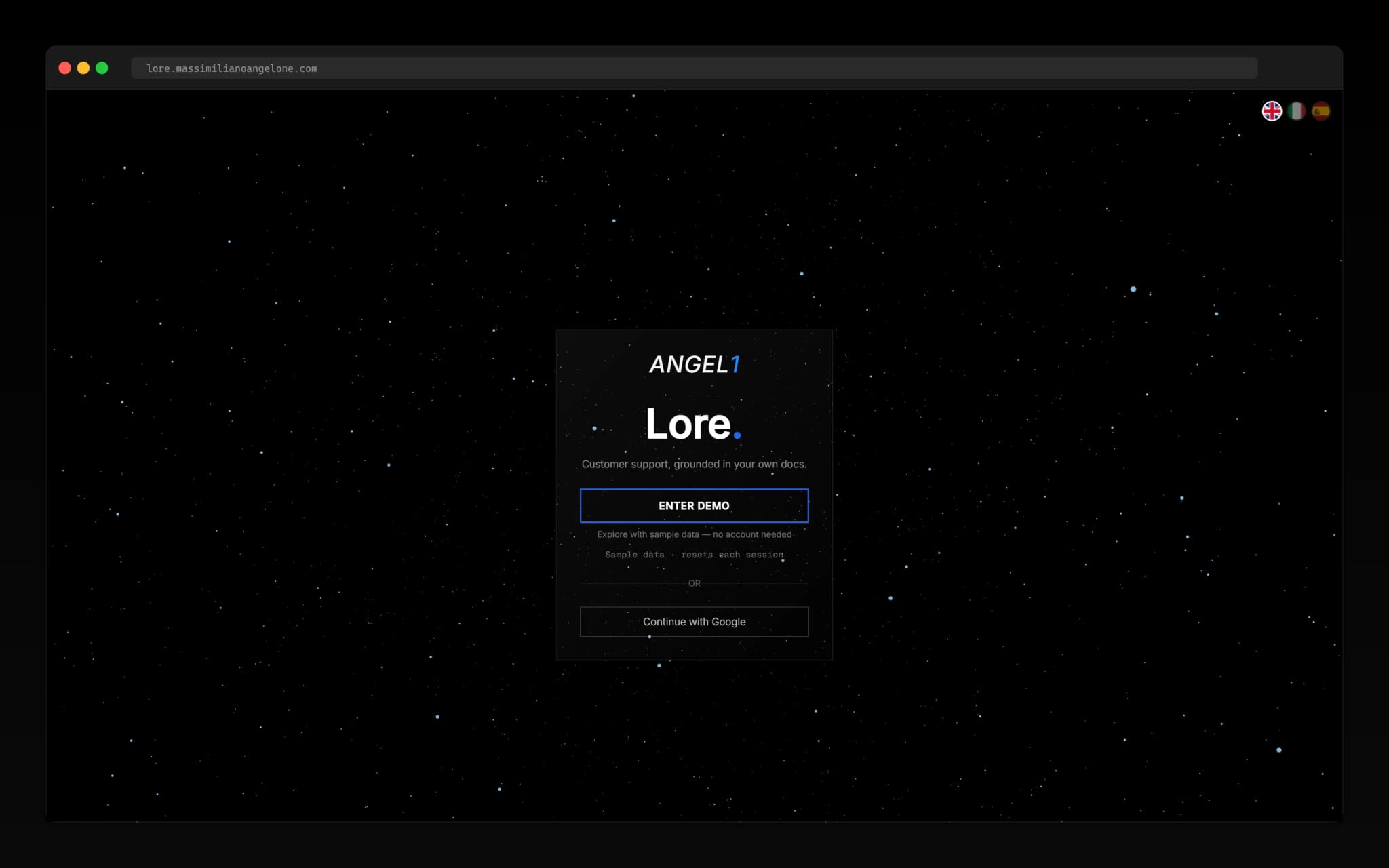
Live at lore.massimilianoangelone.com · Code on GitHub